



When’s the best time to teach your kids about money? The short answer: right now. From toddlers to teens, kids of all ages can — and need to — understand the basics of money management. Here are some of the most important money lessons to teach kids.
What is money?
Kids aren’t born knowing that money is a medium of exchange we use to buy things. We need to explain the concept of money to children – those round metal discs and coloured pieces of paper and funny plastic cards can be exchanged for things we need and want.
To help little kids understand this concept, they can pretend to go shopping, and trade coins or pretend money for items. Or parents can point out when they use cash or cards to buy items in the store. As kids get a bit older, we can get a bit more philosophical in our explanation. Those bills and coins, for example? Unless they’re made of solid gold or silver, they aren’t inherently valuable. Instead, explain to kids that currency is a “points” system that was set up instead of trading a cow for a dozen chickens for some cloth and a sack of flour.
Teens should be able to understand the idea of money as part of a larger system of values. You can talk to them about how others perceive people who have more or less money, or whether money can actually “buy” happiness. Authors of the best-selling book Your Money or Your Life, define money as “life energy.” If you want to buy a video game for $60, and you earn $15 per hour at your part-time job, then you’re essentially trading four hours of your life for the game. Put in that context, teens can decide for themselves if it’s worth it.
Where does the money come from?
Again, when it comes to teaching money skills, little kids just need the basics: we earn money by working. Young children can earn money by doing jobs around the house, while bigger kids and teens can raise cash through babysitting, snow shovelling, mowing lawns, walking dogs, or other side hustles. By the time kids are in high school, a part-time job is a great way to learn about the value of hard work (remember that life energy!) and to find a way to fund needs and wants. Of course, working at a job isn’t the only way to earn money. Kids can also make extra money online.
Teach about saving, spending, and giving
What to do with money once you have it? Whatever your child’s age, there are three basic options: giving, saving and spending.
With little kids, it can help to make these options crystal-clear by using three jars, one for each of these three pillars. Each infusion of cash, whether it’s an allowance or gifts, can be divided among the three jars. For giving, let kids pick a cause they’re excited about. For saving, talk about a goal they want, like a toy or game, but don’t have enough money for yet. Funds in the spending jar can be used for day-to-day wants and needs — but once the jar is empty, they’ll have to earn more money to buy the next thing.
Once their savings have outgrown a jar, you can introduce the concept of “putting your money to work” via the magic of compound interest. If you haven’t already, consider taking your kid on a field trip to the bank to open a savings account in her name — and let them begin earning interest on deposits. Look for a kids’ bank account with no minimum balance, zero fees and easy access to their money.
As kids get older, help them become more sophisticated spenders. Ahead of time, teach them how to save money by collecting online coupons. While you’re shopping, compare the unit price on a box of cereal or a jar of peanut butter to select the better deal. Buy the generic brand of staple items for one week and the fancy name-brand the next week, then compare: is the more expensive one worth the extra cost?
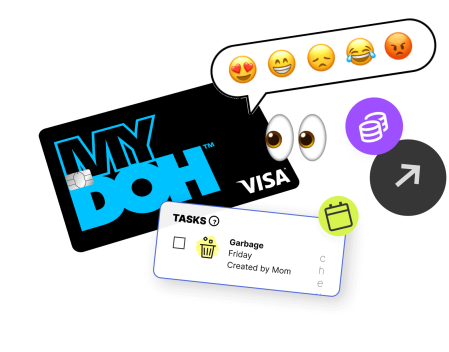
At around age 11, you can move their spend jar online. Mydoh is a money management app that lets parents add funds to a child’s wallet so that kids can start to take more responsibility for purchases. Kids can also create budgets for items like treats, online games, or clothes and then comment (with emojis) on their decisions. Rather than buying birthday or holiday presents, consider adding money to their Mydoh account so that they can make their own budget-based decisions. By the time kids are teenagers, you can transfer even more spending responsibility to them. For example, decide on a seasonal clothing budget and then unleash your teen on the mall to buy what they like.
Teach the value of investing
By about age of 13, teens may be ready to understand the power of investing as a means of building wealth. You can begin by explaining the difference between lower-risk bonds (essentially, you’re giving a loan to the government that they will repay later) and higher-risk, potentially higher-reward stocks. Kids (and parents!) can open a practice investment account to learn how to trade stocks online. Expand their knowledge through books, investment podcasts or subscribe to stock newsletters.
Use financial mistakes as teachable moments
What if your teen blows all their money on a designer sweatshirt and has nothing left for pants? If they spend all her cash on fancy coffees and have nothing left to go out with friends at the end of the week? Don’t bail them out. Instead, work with them to establish (and keep within) a budget, keep track of expenses, and learn how to plan the future. Kids need to understand that money decisions have consequences, both long- and short-term. These kinds of mistakes teach your child the value of money.
By about age 11, it’s important to start talking about the consequences of making poor financial decisions and don’t be afraid to let your kids feel the sting of making a minor money mistake or two. One of the ways you can help facilitate this conversation is by talking about credit. Stress that if you can’t afford to pay with it in cash, then you can’t afford it. Teach your kids how to use credit cards and that it should be paid in full each month. You can drive that message home by using an online credit card interest calculator to show just how quickly credit card debt adds up.
Give your kids real-world experience
Mydoh is a money app that comes with a digital Smart Cash Card designed especially to give kids them some real-world experience of making and spending their own money. Parents can create tasks for their kids to tick off and set up a weekly allowance to their kids’ Mydoh Smart Cash Card.
Learn more about how you can use Mydoh as a way to help your kids learn, earn, and save.
Download Mydoh today to learn more.
This article offers general information only and is not intended as legal, financial or other professional advice. A professional advisor should be consulted regarding your specific situation. While the information presented is believed to be factual and current, its accuracy is not guaranteed and it should not be regarded as a complete analysis of the subjects discussed. All expressions of opinion reflect the judgment of the author(s) as of the date of publication and are subject to change. No endorsement of any third parties or their advice, opinions, information, products or services is expressly given or implied by Royal Bank of Canada or its affiliates.
Family FinanceAs It Should Be
No monthly fee means extra pocket change to go towards helping your kids earn, spend, and save.